The Hofbrauhaus (literally ‘Court Brewery’) in Muenchen was built by a stingy Duke who wanted to save money on his troops’ beer costs, and is probably the most famous beer hall in the world. Distinguishing features of the original Hofbrauhaus include beer served in one litre mass glasses, and drunken Australians, as demonstrated by Naomi, below.
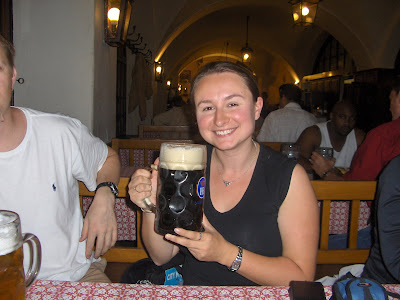
Aiming for authenticity in its replication, Melbourne’s Hofbrauhaus also sports drunken Australians (including one inexplicably dressed in a chicken suit) and offers Hofbrau beer in mass, as well as in smaller, more civilised sizes. It also boasts traditional German entertainment and traditional German serving sizes (huge!). This week Caroline, Naomi, Sai, Flick, Dale and Rami waded their way through mountains of sauerkraut.


 With decor consisting of long, crowded wooden benches, exposed dark wooden beams and warm lamplight, the crowd was certainly reminiscent of the mix of locals and tourists in a Muenchen brew hall. We crossed our fingers that the food would be similarly impressive.
 Entrée
Taggensuppe- Soup of the day- Vegetable
Hauptspeisen- Mains
Goulash with bread dumplings and red cabbage
Braised shoulder of venison with polenta, vegetables and cranberry sauce
Rindsroulade- a beef dish with bacon, onion and mustard, served with vegetables, red cabbage and steamed potato
Krainerwurst- smoked pork and beef sausage, served with mashed potato and sauerkraut
Debrecinerwurst- spicy beef sausage, served with mashed potato and sauerkraut
Susspeisen- Dessert
Apfel strudel- Apple strudel
Schwarzwaelder kirschetorte- Black forest cake
Getranken- Drinks
Hofbrauhaus helles- pale Hofbrau beer
Hofbrauhaus dunkel- dark Hofbrau beer

Germany is well known for its sausage, so it was exciting to be offered a wide range of wurst. However, when the two sausage dishes arrived, they were difficult to tell apart, both visually and in taste. The allegedly spicy debreciner was very mild, causing Rami to fear he may not be eating beef sausage at all. While German sausage is often subtly flavoured, a trend continued in the deliciously smoky krainer, the taste is heightened with the addition of sharp Deutsche mustard.

While Dale was disappointed to be told that the restaurant had run out of their speciality (Muenchner Schweinshaxe, pork shank pickled then roasted), he was more than satisfied with the suggested replacement of rindsroulade, which he described as ‘amazing’. A roll of beef stuffed with mushroom, onion and bacon, this dish was slathered in a rich, meaty sauce and perfectly balanced by the side of sweet, red cabbage.


Paprika, the patron spice of Deutschland featured heavily in the rich goulash. With chunks of hearty, tender meat and the distinctive heat of paprika, this dish was eagerly devoured, leftover gravy sopped up by bread dumpling. Flick and Marty waxed lyrical about their meal, much to the despair of other diners who felt they had chosen less wisely.
 Although they sounded tempting on the menu, the venison and the soup both turned out to be underwhelming dishes. The vegetable soup was unadorned by spices, herbs or anything much of interest. Caroline felt she could have made better soup herself; a bold call, as Caroline does not cook at all. Sai was saddened by the lack of gaminess in the venison, which turned out to have a weak flavour entirely lost in the sauce in which it was drowned. The rubbery polenta side did little to rescue this dish.
 Those of us with a sweet tooth decided to sample traditional German desserts, eagerly anticipating rich, dark Black Forest Cake and light, warm Apple Strudel. Alas, the airy sponge arrived heavily layered with sweet cream, and the strudel was dense, cold and featured a distinctly gluggy filling.

The Hofbrauhaus seems to be somewhat of a novelty venue, and it comes at a standard novelty venue price. The duke may have saved a bit of cash at his own personal brewhouse, but mains at this Melbourne inn will set you back at least $20 each. While the bland flavours and lack of variety on the menu don’t appeal to more cosmopolitan tastes, the Hofbrauhaus is paramount in recreating the boisterous atmosphere of a German beer hall. It proudly offers the traditional Bavarian mass of Hofbrau, and regularly features an oompa band and yodelling; if you time your visit well, you may also have the opportunity to enjoy some authentic German slap dancing. Feel free to compare this montage with a similar display of Rami and Caroline’s dancing in our Austrian review a few weeks ago. Rumours that their dancefloor experience similarly ended in blows can not be confirmed...


